Closed-loop drilling automation
Autonomous directional control, machine-learned torque models, and operator copilots replace manual tuning windows with continuously optimized rotary steerable behavior.
Baker Hughes pairs proven surface and downhole hardware with subsurface intelligence, edge computing, and new materials research. The goal is not a showroom of gadgets; it is a measurable improvement in well delivery cost, operational risk, and emissions intensity for every basin, mine, and geothermal field we work alongside.
 R&D invested across 12 energy transition platforms
Each pillar is a funded research and commercialization track with clear field adoption milestones. Teams can engage at any stage, from pilot to scaled rollout across a country portfolio.
Autonomous directional control, machine-learned torque models, and operator copilots replace manual tuning windows with continuously optimized rotary steerable behavior.
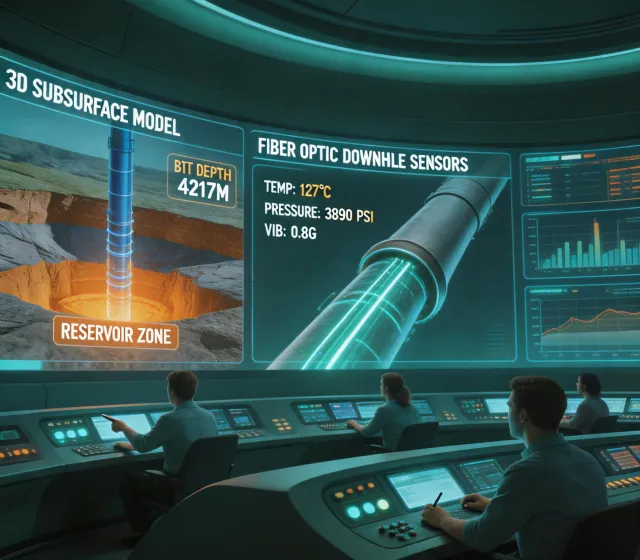
We fuse seismic, offset logs, LWD curves, and drill-string vibration into probabilistic earth models so bit programs and casing plans react to what the rock is actually telling us.
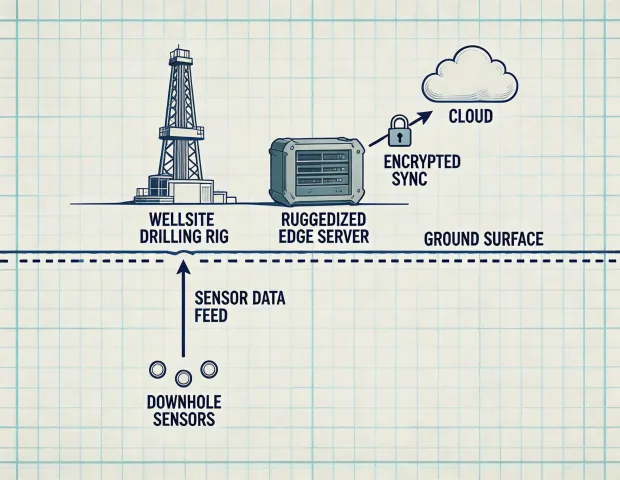
Ruggedized edge nodes ingest sensor streams at the rig floor, run inference within milliseconds, and only relay compressed decisions upstream, keeping remote sites productive under thin bandwidth.
Diamond-enhanced cutters, high-nickel elastomers, additive-manufactured manifolds, and non-metallic liners extend duty cycles in sour, geothermal, and abrasive mineral service.
Injection well integrity tooling, CO2-rated completions, plugging diagnostics, and geologic storage monitoring bring the same engineering rigor to storage assets as to producing fields.
Battery augmented gensets, grid tie-ins, dual-fuel packages, and smart load shedding cut diesel burn and flare volume without sacrificing drilling performance envelopes.
Latency matters when drill-string vibration, ECD excursions, or stuck-pipe precursors emerge within seconds. By moving inference to the wellsite we remove the round trip to distant data centers, preserve data sovereignty in regulated basins, and keep automation loops reliable even when satellite links degrade.
Our research portfolio is sequenced so operators can adopt mature tools today while co-developing the next wave with us. Each horizon lists representative initiatives currently funded under the Baker Hughes technology roadmap.
Technology that reaches production has to survive peer review, field pilots, and harsh environment soak tests. Our partnership model puts external researchers and customer engineering teams inside the development loop from day one.
Joint chairs in drilling automation, subsurface ML, and materials science with leading engineering schools.
Multi-client programs that validate new rotary steerable, fluid, and monitoring systems under live contract conditions.
Invested equity positions in geothermal, hydrogen, and carbon storage ventures that need proven well construction know-how.
Co-funded work on methane mitigation, measurement standards, and safer high-pressure components.
Whether it is a geothermal pilot, a first-of-kind CO2 injector, or a digital rig migration, our engineering teams are ready to scope the work and shape the pilot with you.